Showing posts with label Roses. Show all posts

Monday, June 11, 2012

Roses: Top Tips

Roses!

Keeping them in tip top shape.


Fame, a grandiflora

Roses, favorites in the garden and the vase, take a little bit of attention to keep them blooming and looking their best.  Here are some tips to keep them the showpieces of your garden:

Fertilizer:  Feed after each bloom cycle with a fertilizer that promotes bloom (look for a fertilizer that has a higher phosphorous content, that's the middle number in the three ingredients, 4-6-4: nitrogen, phosphorous and potassium).


Angel Face, floribunda
 Disease Control:  Roses are subject to fungal diseases such as blackspot, powdery mildew, and rust.  To prevent these diseases, keep foliage dry by using drip or soaker irrigation, or watering early in the day if overhead watering.  Spray with fungicides per directions to prevent or reduce occurrence.

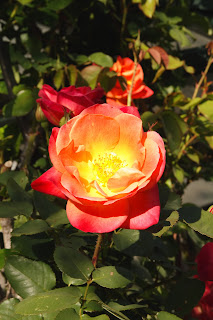
Joseph's Coat, Climber

Pest Control:  The best pest control method is you in your garden!  If you see pest damage early, it's much easier to control.  Practice Integrated Pest Management (IPM), which means using the least toxic method to control pests.  Keeping plants healthy with proper watering and feeding keeps plants resistant to pests.  A strong squirt of water from a hose nozzle is often enough to get rid of aphids.   Insecticidal soap usually controls a number of pests.  Avoid broad spectrum insecticides if possible as they also kill beneficial insects.

Deadheading:  Pick your roses often!  This encourages new blooms.  Cut off spent blooms from the plant at an outward facing five leaf leaflet.  This will result in the growth growing out from the bush rather than towards the center of the bush.

Happy Gardening!


Friday, January 20, 2012

Roses: Plant Bareroot Now! Cheap and Easy!

What is a 'bareroot' rose?
It's a dormant rose bush which has been dug up by the grower, soil removed from roots, canes trimmed, usually packaged in sawdust in a plastic wrapping.

Why plant bareroot roses?
1. Selection: Many more varieties are available during bareroot season both at your local nursery and online.
2. Easier to Plant: Instead of wrestling with a 5 gallon plant, 1 1/2' to 3' tall and full of thorns, a bareroot plant is only about a foot tall with no soil attached.
3. Cheaper!: Bareroot roses are often less than half the cost of a rose bush in a nursery container.
4. Less Transplant Shock: Because the plant is dormant, it is less likely to experience transplant shock.

How to Plant Bareroot Roses
1. Unwrap plant, shake off sawdust, trim off any damaged roots, and soak in bucket of water while preparing planting hole.
2. Dig hole 2' wide and 1' deep. Amend removed soil with 1 cubic foot compost and granular fertilizer (follow fertilizer instructions).
3. Make 10" cone of soil in hole, spread roots of rose over cone of soil making sure graft (bump on main stem above crown)is above surrounding ground level. Back fill hole about three fourths full.
4. Fill hole slowly with water until muddy looking. Wiggle rose bush to settle in. Continue to backfill until soil is even with surrounding soil. Make watering basin with additional soil and water plant again.

Bareroot Rose Sources
Two of my favorite online bareroot rose sources are Regan Nursery and Jackson and Perkins:


Careful, it's addicting! I have over 100 roses!

Saturday, December 31, 2011

8 Simple Steps to Perfectly Pruned Roses

'Joseph's Coat' rose

Although roses in Southern California never really go dormant, this is the time of year to give them an annual pruning.  It's tough to do since many plants are still blooming!  Pruning, while sacrificing a few blooms now, will result in a healthier plant and, therefore, better blooms in the coming year.

Rose pruning instructions are often somewhat complicated and intimidating.  But if you just follow these 8 steps, you'll have roses ready to bloom their heads off come spring!

8 Steps to Perfectly Pruned Rose Bushes

1.  Canes (branches) growing towards the interior of the bush:  Remove all, cut flush to a main, outward facing cane.
2.  Canes crossing one another:  Choose the most healthy, vigorous looking, and outward pointing cane and cut off the other.
3.  Dead, diseased or old woody canes:  Cut off at base of plant.
4.  Canes thinner than a pencil:  Cut off flush to a main cane or base of plant.
5.  Shorten remaining outward pointing canes by one third of their length cutting 1/4" above an outward pointing leaf node.  The goal is to have 3 to 7 outward pointing canes growing from the base of the plant.
6.  Remove all leaves from plant.
7.  Remove all fallen leaves and debris under and around plant.
8.  Spray pruned shrub and ground with a dormant spray.*

The goal is to have a resulting bush that is shaped like a v-shaped vase, open in the middle so that it could hold a beach ball in the center of the bush.

* Dormant spray is a horticultural oil or fungicide or combination that is sprayed on the plant while 'dormant'.  The oil smothers insects and fungal spores and the fungicide deters fungi such as those that cause black spot, powdery mildew and rust.  Pre mixed sprays for roses are available at nurseries or home improvement stores, or you can make your own:

Cornell University Formula:

1 gallon water
2 tablespoons fine horticultural oil
1 tablespoon mild liquid soap (not detergent)
1 heaping tablespoon baking soda (acts as a fungicide)

Stir each addition thoroughly.  Put mixture in clean sprayer and spray plants thoroughly.